
Application
Crude salt (KCl and NaCl) is mixed with saturated solution (mother liquor) and is ground finely (crystal size ~ 1mm). During the optional purification stage impurities are separated and the pre-purified solution is stored temporarily. In the flotation cell the KCl crystalls are covered by surface-active substances. Air bubbles are injected into the flotation cell which adhere to the KCl crystals. This generates a KCl foam, which is mechanically seperated. Meanwhile, the non-binding NaCl crystalls sedimentate and are posttreated in thickener and clarifier.
Frequently, more than one flotation step is needed. The purified KCl-suspension is drained by drying or centrifugation, whereby solid KCl and re-useable process water are produced. Each process step ,e.g. the crude salt dissolution, can be real-time monitored, regulated and optimized. LiquiSonic®benefits customers by its robustness, with quality improvement and economic advantages.
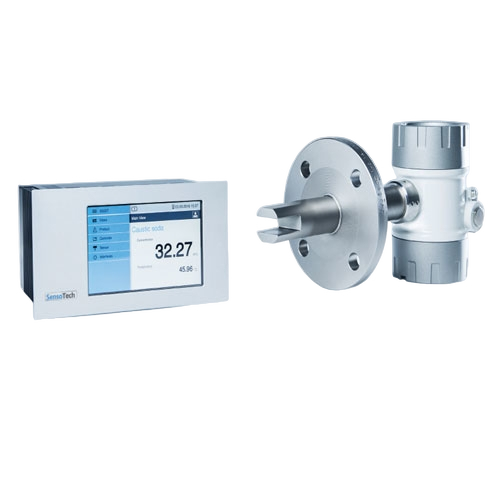
The LiquiSonic® immersion sensor can easily be installed directly into tanks or pipelines, and is well-equipped for measurements in solutions and suspensions. In partially filled pipes, installation from below is recommended. By using the LiquiSonic® controller 30, up to four sensors can be connected, allowing the whole flotation process to be monitored at different measuring points including:
• mother liquor input
• crude salt dissolution
• clarification
• flotation unit
• KCl drainage
Typical measuring range:
• concentration range: 1100 to 1600 g/l
• temperature range: 10 to 40 °C (50°F to 100°F)
The LiquiSonic® analyzer provides a precise inline concentration measurement with real-time monitoring. The robust sensor construction and the optional special materials, like titanium, promote long process life.
Additional advantages are:
• optimum line control and reliable process data
• increasing the efficiency of flotation
• drift free measurements over years
• early recognition of malfunctions in a matter of seconds
• reduced maintenance, materials and energy